Pastoral Corner
Greetings! Ascension of the Lord
For several years, we have used this week-- between the Ascension of the Lord and Pentecost—to acknowledge the Sacramental life and gifts in our parish throughout the past year. As you pray this week ---please remember in your personal prayers ---all of these people who have touched the Lord in a very special way from May 2011 thru May 2012.
Baptisms
Violet Grether Felix Olsav Greta Lee
Liam O’Connell Kenneth Blair Isla Glasgow
Maximus Bomotti Dariel Mazarra Molly Hannon
Conor Hannon
Welcomed to Full Communion through RCIA
Angel Almanza
First Reconciliation and First Eucharist
Nicole Makinica Capulong Gianni Dixson Aubrianna Dixson
Alessandra Dixson William M. Ernst Olivia J. Grether
Terence O. Holton Nicholas C. Houston Benjamin J. Johnsen
Fiona K. Kelley Sophie M. Kruse Raymond F. Makinica
Thomas Young-Min Oh Daniel T. Suhr Conar J. Suhr
Brandon A. Stiverson
Confirmation (High School)
Lucas Burns Abigail Diess Padrick (Paddy) Ellis
Riley Marie Ford Matthew Hart Peyton Jo Hill
Jamie Norville Lucy O’Sullivan William Paustian
Timothy Salu Crawford Schafbuch Joseph Wilson
Marriage
Zachary Wachlarowicz and Nicole Morris
William Leathers and Maria Vilma Montejo
Funeral (not a sacrament but a Celebration of Life)
Chris Bell Lidia Cettina Rose Amato
Dellise Amato Frances Navarra Janet Gaudio
Don Westhusing Ovidio Percic Allen Peterson
Rosalie Vogel Ben Del-Rosario Finley Andreas,
Frances Schimel William Arata John Irwin
Greta Gonzales
Deo Gratias, -Barbara M. Harrison
Seeing
God in the Bad Stuff by Fr. Michael
Last Sunday I was sharing with our young people in the
religious education program about experiencing God in daily life. Specifically, how do we see God and how do we
hear God? We went back to the very
beginning of time, and the Book of Genesis, and I asked them what
happened? One said that God exploded a
big rock, and I guess that will do for the big bang theory. Obviously I was trying to get them to think
about God's very first Word through which all that we hear, see, taste and
touch came into being. Then I suggested
that after God's great big Word God began speaking billions and trillions of
little Words, a Word for every person, for every flower and rain drop, a Word
for every sound we hear and every sight we see.
Well, they kinda got into all that and then I opened up for any question
at all they might have.
One of the parents asked, how do we see and hear God in
the bad stuff that goes on in our lives?
I said, children's questions only please. It is however an important question, a very
important question. Oh it is easy to say
we see God in a sunset, or a full moon, in the beauty of new life or in
generous and selfless acts of compassion; but to see God in the really bad
stuff, that is both difficult and very necessary.
I have come to believe that God is closer to us in the bad
stuff than in the good stuff. Our
deepest insights into God, and our deepest spiritual conversions happen in the
difficult times we find ourselves in.
Trouble is, we spend so much effort fighting against the bad stuff,
moaning and groaning that life isn't fair or suppose to be this way. We constantly focus on what's happening to
me, or why is this happening to me; so caught up in ourselves that we have no
room left for God or anyone else for that matter. This is where my favorite mantra comes into
play: "acceptance is the key to happiness." We can't take, or accept, the next right step
unless we have some calm, and have made some room for God and the compassion
and love of others in our lives.
Acceptance doesn’t mean that we like something, just that we have
stopped fighting with what is before us.
When we stop fighting we can see and hear more clearly both the voice of
God and the possible solutions others might share with us.
At UCLA I spent a lot of time with teenagers with terminal
cancer diagnoses, some came out alright, others didn't, but most of them
developed a depth of spiritual union with other teens in the same situation,
and with God that takes most of us more than a lifetime to achieve. Acceptance
was always key, then of course the next best steps in terms of treatment,
loaded with lots of hope.
I have been doing a lot of reading lately in and around
the spirituality of St. Francis. St.
Francis always brings one back to the crucified Christ, which tells him and us,
in the image of the crucifixion that God is most certainly with us in the very
worse of times. I don't like being taken
there, but unless we see God there we will never appreciate God in the best of
times. Unless we can see God in the
poor, the outcast, the castoff, the alien and stranger, we will find it all
more difficult to see God in the person sitting next to us. When we, like Francis, can freely kiss the
leper, then we can freely embrace all of God's beautiful creation.
Fr. Michael Evernden, CSP
Pastoral
Corners
"I am the true vine and my Father is the
vine grower. … I am the vine, you are
the Branches.… without me, you can do nothing."
The "I'm
spiritual, but not religious" mantra is very prominent in, but not
limited to the northwestern United States.
Many people everywhere in today's culture ask, "Why bother going
to Church? I can worship God well
enough in my own way, in the great outdoors, at the beach, even in an art
museum."
Not so however, for
those who call themselves Christians, and especially so for Roman Catholic
Christians. From the earliest times, Christians could not see themselves as
worshipping God apart from Jesus. And
following Jesus was never only a private or personal matter.
Acts of the Apostles
tell us that the early Jerusalem Christians actually lived a common life
style, some even living in community.
Elsewhere, in Corinth, Galatia, Ephesus, etc., the early followers of
Jesus came together weekly for the sharing of the Scriptures and then in each
other's homes 'for the breaking of the bread'.
The reason for this
coming together in community was given by Jesus himself when he said, "I
am the vine, you are the branches."
The vine and the branches are one with mutual interdependences. You cannot separate them. To separate following Jesus from being a
part of the community of faith, from being a part of the Church, is to cut
off the branches from the vine. As Jesus has said, "without me you can
do nothing."
The first disciples
had lived lives very connected with Jesus throughout his public ministry and
the resurrection stories show that same connectedness -- of seeing and
touching and eating with him after his resurrection.
They also came to
understand that it was precisely because they remained connected to him, he
living in them and they in him, that they were then sent and empowered to
bear much fruit. It was never about
themselves. It was always about their
allowing Jesus to continue working through them.
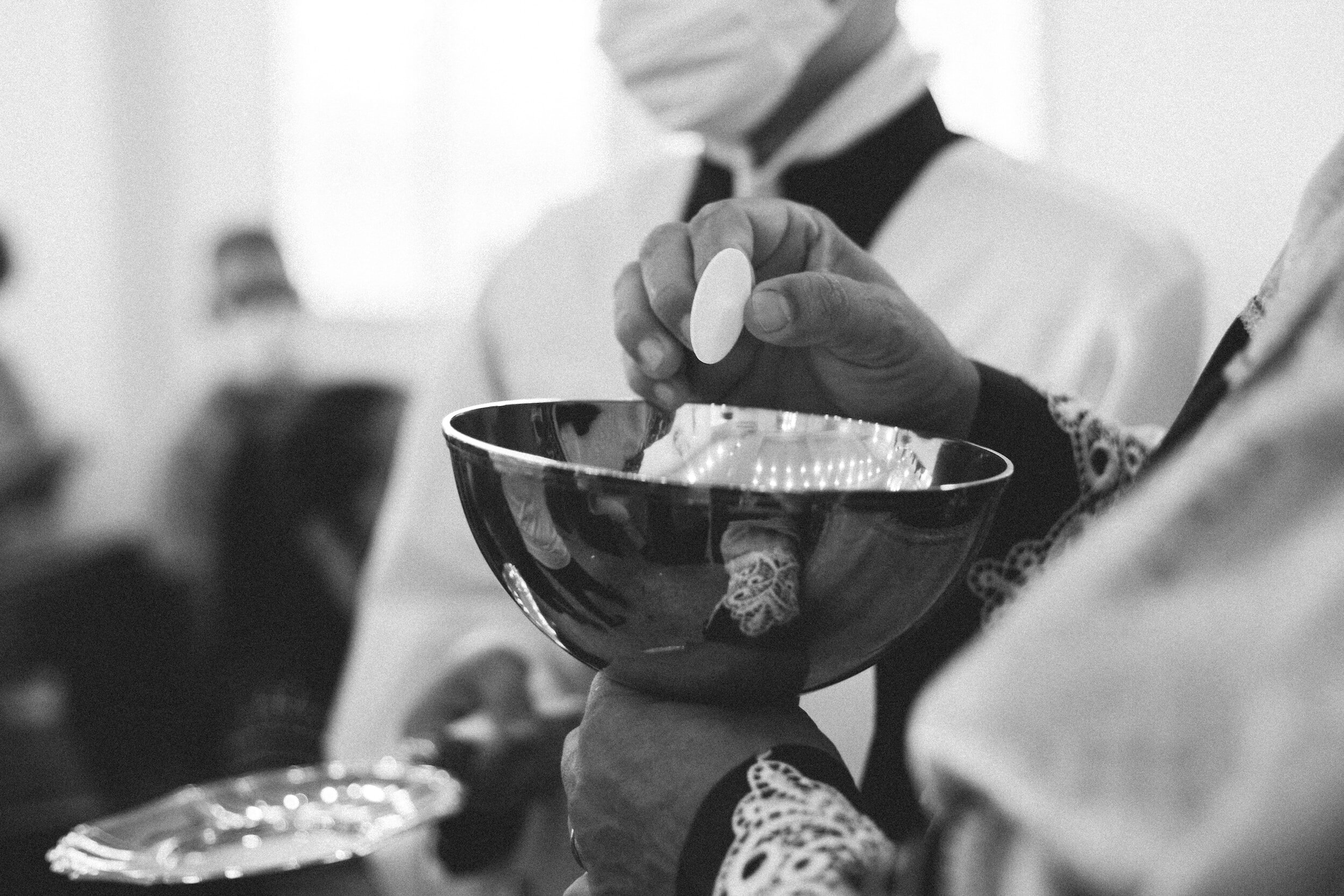
The Eucharist we
celebrate was Jesus' way of continuing his presence among the disciples and
is still his way of continuing his presence in our lives. The Eucharist we celebrate continues to be
Jesus' way of feeding and nourishing us and sending us forth to bear fruit in
his name.
The spiritually of the
Christian flows from our being a part of Christ's body. He is the vine and we are the
branches. He is the head of his body,
the Church. The followers of Jesus
cannot be truly spiritual without being truly religious.
Fr. Charlie Brunick, CSP
Lord Jesus, Open the Scriptures To Us
Ever since God first called Abraham, God has never stopped speaking to us human beings. God desires that we know him and his love, so God sends his creative Word out, and it always accomplishes what he sends it for. But, of course, we with the freedom God has given to us can choose whether to listen or respond. Still, because of God’s infinite love, wisdom, and power, his Word is eventually accomplished. There is no time for God, of course, because God always IS, God’s Word is never late; although it may seem that way to us, who live out our lives “in Time.”
I am writing to you today to encourage you to spend time with God’s Word in Scripture, every day if possible, or at least several times a week. During this Lent many of you joined Living The Eucharist small groups in which you reflected on the Scriptures as a kind of guide through Lent. You may have discovered a traditional method of reflecting prayerfully on the Word of God called, Lectio Divina, which means something like “Sacred Reading.” It is an easily learned, and adaptable, method of prayerfully reflecting on a short passage from the New Testament, usually, and then bringing it to prayerful sharing.
We Baptized have a particular advantage when it comes to understanding the Word of God. Jesus “breathed” the Holy Spirit upon the Church from the beginning, opening the Scriptures to us. Now, this doesn’t mean that we receive understanding magically without any effort on our part. It does mean that Jesus has promised the help of the Holy Spirit so that the Word can feed us, and challenge and console us; as we spend time prayerfully reading and pondering the Scriptures. It does mean that the Holy Spirit will be at work helping scholars and bishops lead us to greater understanding and even interpretations when we need them.
The Church has not been led by the Spirit to offer precise interpretations for most of the Scriptures. But we do find understanding living as members of the Catholic Church under the leadership of our shepherds. The Holy Spirit is always active in the whole process of the spreading of the Word so that we will not go astray from the Faith given us by Christ. So the Spirit is at work in the writers of Scripture, in priests and bishops and Pope who preach, and at work in those who listen to their preaching. God wants us to know Him and to know His love.
Fr. James McCauley, CSP
Death! Where Is Your Victory?
Easter 2012 Fr. Charlie
Brunick, CSP
Death is
perhaps the most feared word in the English language for many contemporary
Americans. People go to great lengths to avoid even using it. Even Christians
seem to have gotten caught up in the phenomenon. Friends and relatives rarely die anymore. They 'pass', or we 'lose' them.
The
awesome greatness of Jesus' resurrection lies in the fact that he truly died.
As we used to proclaim in the liturgy: Christ has died! Christ has risen! and,
Christ will come again! We didn't say Christ has passed or Christ got lost.
And, we can't fully grasp the great fact of the resurrection, and it's meaning
in our own lives, unless and until we proclaim that Jesus really did die.
Jesus
died in darkness. Jesus entered fully, even willingly into the darkness of the
unknown, with all the human fear and trepidation most of us associate with
death.
But
Jesus' faith was a living faith. His
faith was a dynamic faith. Like Abraham,
his ancestor in faith, and like his mother, Mary, in the story of the
Annunciation, Jesus believed even when he did not fully understand.
"Father, let this cup pass from me……but, not my will but thy will be
done." He really believed and trusted God enough to face the darkness of
the unknown and trust in God's love. He
willingly let go of life. "Father,
into your hands, I commend my spirit."
And he willing embraced the darkness of the unknown.
Trusting
God enough to accept death, even death on a Cross, Jesus embraced the darkness
of the tomb and waited for God to raise him up. Jesus entered the dark kingdom
of death, and emerged victorious. He has won his victory ‑ he has conquered
death. Fully human, through faith in God, Jesus has show the way for the rest
of us human beings to achieve the same victory.
On one
level, the resurrection itself was never in doubt. God cannot die. But Jesus, known by an experienced as fully
human by the Apostles, disciples and his followers, now opens the way and shows
the way for all human beings to defeat death as well. The early Christians
proclaimed in many different ways: 'If we live in the Lord and die in the Lord,
we shall truly rise in the Lord.'
Death
constitutes a huge challenge to every human's faith, because as Paul says, we
see now only as through a glass, darkly.'
The forces of darkness may seem overwhelming, but the victory is already
won. We must trust that victory, and not live as if death still dominates us.
To be a Christian is to be a person of hope because of what happened on the
third day.
But
Christian hope is not a superficial, an optimism based on a refusal to look at
the facts. Rather, it is a deep trust in God. Good Friday, day of darkness and death,
comes to everyone. So does Holy Saturday, that day of emptiness and sorrow. On
such days it's hard to believe. But Easter Sunday, day of life and joy, will
come as surely as the dawn. Death, the last enemy, has been overcome.
Today,
may the Lord in his goodness open our minds and hearts so that we may believe
the good news of his victory over death. In his love for us, God draws us
outwards into the unknown, the beyond, the infinite, the eternal. We go forward
more confidently and hopefully because Jesus our Brother has gone ahead of us. Happy
Easter everyone!!! Fr. Charlie Brunick, CSP (Some
themes and ideas drawn from the writings of Flor McCarthy, SBD)